Episode Transcript
[00:00:06] Speaker A: Welcome to Foraging, a podcast about environmental humanities.
In this second season, we step into the Foragers engagements Beyond the Human, a series of public events that brings together artists, researchers and enthusiasts around the practice of foraging.
It starts with simple what grows here? What can we take? What should we leave?
From there, we move into bigger conversations about care, community consumption, and the way we relate to more than human worlds.
We also explore how artistic practices can sharpen those questions, complicate them, and reframe them.
My name is Jose Verflusum.
I'm a performance and visual artist and co curator of the Foragers.
Plants are a constant presence in my practice. Their stories, their imaginaries, and the new languages they open for the complexity we're living through.
In each episode, I invite two artists from the Foragers. We talk about their work and what foraging means in their practice as a method, a metaphor, and a way of asking better questions.
Not only what can I take? But also, what does this place ask me in return?
I hope these conversations can inspire you.
Let's begin.
So we are here today with two artists who are part of the Foragers project, Sama Hijari. Hello, Sama.
And Juliette Mourad, AKA Kinhans. Hello, Juliet.
[00:01:49] Speaker B: Hey.
[00:01:51] Speaker A: We will explore their work, their practice, and how it relates to the thematic of foraging.
In the coming hour or so, we will dive into their artistic world and collect, gather, forage, connect topics, issues, challenges that are driving those artists practice.
Sama, you are a multimedia artist. You describe yourself as a painter, a performer, an astrologer, a storyteller, a researcher, an academic and a cook.
[00:02:27] Speaker C: Yeah, that's a long one.
[00:02:28] Speaker A: Voila. Your projects are always deeply rooted in historical narratives, which are.
Which use, actually, which you use to reimagine our contemporary life outside of radicalized and polarized discourses.
And your research focuses on the movement of food practices over time and across geographies.
It materializes in food maps and performative dinners.
You will, in the Expo the Foragers, you will exhibit a series of drawings.
Can you describe that work to us?
[00:03:10] Speaker C: Thank you very much for having me. It's nice to be having this conversation with both of you today.
So what you described is actually probably an outdated version of my biography on my website.
Well, outdated in the sense that from what you described, indeed, like that. I was working with food, food history.
I was interested in looking at migration because I'm living in Belgium and I see how much food, how much variety of food and cuisines come here because of migration.
And indeed, I'm also an astrologer. And so over time from that project, I didn't really realize that's what I was doing. But I ended up very early on also connecting that story of food to the planets, which is the basis of the work that I will be exhibiting in the Foragers exhibition.
Because of my research in astrology and food, I realized, of course, ancient agricultural calendars were very closely timed with the planets, their movements, which zodiac, and they get really elaborate, like if you go back to ancient texts. And I'm interested in the Arabic sources because it's closer to my region, but I'm also interested in how the that was passed on to Europe, which is not.
This link to Europe is not a history we know enough about.
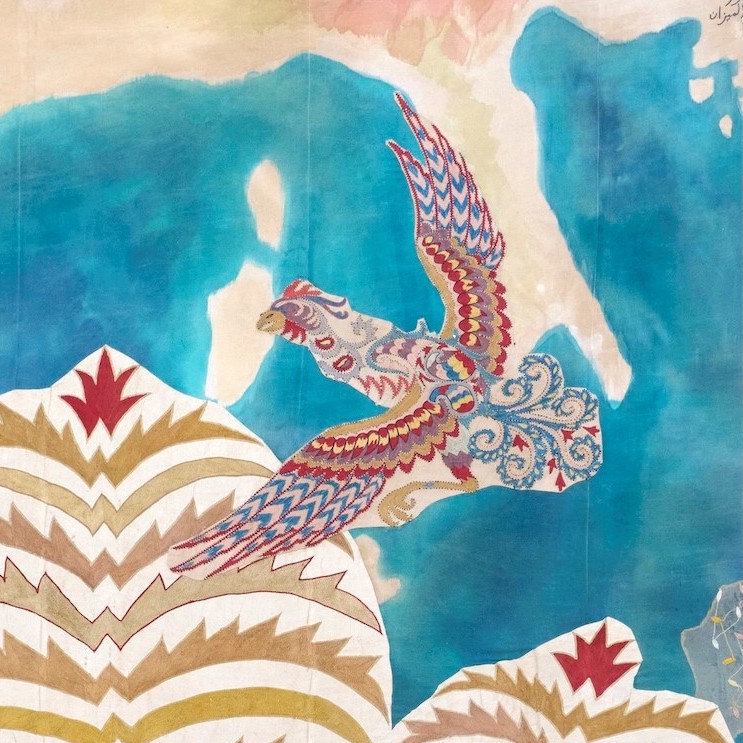
And so in the exhibition, I have a series of drawings that are based on some plants that we eat, and they're called plant cosmologies.
So I take one plant that we eat, and then I map out which zodiacs it's connected to which planets, and then I make a drawing, and then I write a little bit about these connections.
And I will show five pieces, one for pomegranate, one for za', atar, which is oregano, olives or olive tree rice.
Dates, of course.
[00:05:21] Speaker A: Of course.
[00:05:21] Speaker C: Fine. Right. Yes.
[00:05:22] Speaker A: Voila. We have them here in the studio. Also the dates. Yes. We can afterwards try some of the dates you brought. Yes, but to Juliette. Juliette, you are a forager and a storyteller.
You graduated in architectural studies, oriented towards landscape and territory.
In your work, you focus on the significance of place, often through botany, and your artistic practice is devoted to writing and to arts, including foraging, ethnobotany, seeding, planting and making earth pigments and natural inks.
You work with the Brussels based association Le Debut des Aricaux, leading citizen workshops on urban agriculture.
You will lead a workshop for the Foragers project.
Can you describe what the workshop will be and what people will be doing?
How you envision it?
[00:06:24] Speaker B: Yeah, absolutely.
It's very inspiring to be here to hear both of you converse. I'm very excited for today.
The workshop will be.
The goal for me is to bring attention to place and enter through the doorway of simply noticing what is already growing on the campus.
Are there plants that we can eat from? What is growing there?
What can we forage or pick?
How do we do that responsibly? And then how do you prepare that to eat in a small group? The idea, of course, is to do it in group in order for.
I mean, yeah, because it's this doorway of noticing it's also noticing together and relating to each other and to the plants. It's very. To me, foraging is very connection and kinship based. And so doing that in group is wholly different from simply going and being like, oh, I know this one, I'll just pick all of it and go store it in my freezer.
So that's what the workshop will be about.
[00:07:37] Speaker A: And we will be cooking and eating. Yes. Tasting.
[00:07:41] Speaker B: Yeah, certainly tasting very much. Smelling and cooking and incorporating that in otherwise daily meals.
[00:07:50] Speaker A: Yeah. And on our way here, we were working on the campus and we lost you for a bit. I thought your attention was drawn to a plant.
[00:08:00] Speaker B: Absolutely. That tends to happen to me on walks, in groups. I'm usually trailing behind.
One reason is that I have short legs. The other reason, the other reason is that I am very much drawn to plants. So there was one I was like, I'm not sure what is it? And I think it was a buttercup, the leaf of a buttercup which has not yet flowered.
[00:08:23] Speaker A: So yeah, I also saw some beautiful dandelions on our way here.
Really? Yeah. The campus seems to be teeming with.
[00:08:32] Speaker C: Yeah.
[00:08:33] Speaker A: So it's super exciting for your workshop.
Sama, in your work you also forage, but foraging takes maybe another dimension. Can you describe that a bit?
[00:08:49] Speaker C: Indeed. I think I don't forage per se, as in go out and collect. Well, I tried to, but then I'm a little bit too experimental. I don't know what it is that I'm putting in my mouth. And sometimes I get a very bad belly ache.
So I thought, okay, maybe this is not for me, but you should come to the workshop. I should come to the workshop because I've done really silly things. I mean, I've really put things. Cause sometimes I will pass by, I'm like, oh my God, that looks like Zaatar, you know, and then I'll pick it immediately. The instinct is to put something in my mouth.
And one of my friends, Philippines, she's always like, oh, did you finally find something to put in your mouth?
Because I'm constantly, constantly as I'm moving around, picking things and putting them to taste them. But then I get a belly ache. So I thought, okay, better not. So I come to the workshop and learn a little bit more. But for me, foraging is a bit, maybe the approach in which I'm trying to create these artworks, these visual drawings and sometimes even tapestries in trying to make these wild connections. Picking information from ancient books, manuscripts, from contemporary astrological readings. And I'm an astrologer myself. So I'm very close to building it as I go along because it's a very intricate science, if you like, of interpreting the connection between us and the planets.
And so maybe I am foraging in the sense that I'm bringing old and new material together, following an old tradition of the manuscripts that would describe our relationship with the plants and how they're influenced by planets and then how they influence our bodies.
So maybe in that way I forage.
[00:10:41] Speaker A: Yeah, you describe yourself also, or you are also an artistic researcher. And maybe there is something a parallel to be made between artistic research and foraging.
[00:10:52] Speaker C: Yeah, indeed it is, because sometimes I think like, oh my God, I'm almost doing another. Every time I want to do a work, I'm doing a PhD, you know, I take this deep dive and pull out all this material and then my head's all over the place.
But yeah, from that deep research, very close into, like, also boring academic books, like, I love them.
And then images, a lot of ancient images inspire me and thinking like, ah, how did people represent their world and this interconnectedness of worlds? And so, yeah, there is something there also in pulling at different. Even like language, like the language in which you describe the world has of course changes because it depends on, you know, what's the accepted way, what's the latest lingo in science or in popular culture. And so, yeah, in that sense, I think I'm also pulling at material, bringing them together and cooking them up and seeing how they.
[00:11:54] Speaker A: Yeah, how they mix.
[00:11:57] Speaker B: Hearing you Samah, it makes me think a lot. You know, earlier you talked about agricultural calendars being very much attuned to the astrological movements.
And one thing foraging has taught me, especially as a migrant living in Belgium, is this attunement to seasons. Because one plant can be forageable now and it's just for a week, and then next week it's not going to be the right stage to forage anymore.
And so it requires to be very noticing and attuned to seasons. And I love how that can be superimposed onto astrological interests as well. Or like not interests, but you get me.
Yeah, yeah. Is this question of timing and season and the right time for everything, but not everything all the time.
I find that it's also very humbling as an experience.
[00:12:57] Speaker C: It's humbling and it's also. It makes you. When you think about the astrological calendar in relation to agriculture and harvest, for example, with the olive tree, and this is taken from a book and we don't know what the original date of the book is. But the Arabic translation is 3,000 years ago, around two and a half to three.
But anyway, it doesn't matter. So anyway, the olive tree is connected to the planet Saturn. And then they're like, if you're going to harvest or take its branches and leaves to be used as a tea or as a. They used to use it as a protection also they will take a piece of branch and put it on the doorway. And then you have to take it in the cardinal signs. That's when you take it. Because the cardinal signs very.
[00:13:45] Speaker A: What are the cardinal signs?
[00:13:46] Speaker C: No, let's not go there. It's too extra lingo. But can you explain this in the cardinal signs are.
In short, they're the zodiac of Libra, Capricorn and Cancer. And these are very active.
The cardinal element is one that is active, doing, organizing, needs to be busy and feels really good when they're being productive.
And so you have to make a bit of jumps with then its connection with the olive tree.
[00:14:25] Speaker A: And if you harvest in the cardinal signs.
That's what you were explaining. You were saying, like, if you harvest under the cardinal side, we lost our threat here. That happens when you're foraging.
[00:14:37] Speaker C: But that's why I meant. It's really hard to explain astrology in a basic way. But anyway, the olive tree is connected to the planet Saturn and the cardinal signs in astrology, which goes back to the timing you were talking about. You're really wanting to wait for the planet to be in the right place at the right time in order to take the most, you know, the plant in its most active form.
[00:15:06] Speaker B: No, I mean, even without making the effort to attune myself to the current astrological movements. I know, for instance, one of my favorite plants here in Belgium is the elderflower. And so elder is going to flower at the beginning. Elder is a marker of summer. It flowers at the beginning of the summer and the berries are ripe at the end of summer. So it's really a marker for that season.
And you can harvest it basically as soon as it flowers. But it does not smell the same on a hot, sunny, dry day than it does on a rainy day. And so you need to be around all the time. Oh, today is sunny. So today I can go harvest. And it's almost anxiety inducing for me because you can miss a season like that.
But it's, it's really exciting as well. Like it's just the right time.
[00:16:03] Speaker C: Yeah, yeah. That's beautiful how you describe it, especially here with the weather being like very interchangeable even in A season which is not something where you and me come from in the Eastern Mediterranean. It's a bit like, okay, summer, then it's summer, we're done.
[00:16:19] Speaker B: There's no fussing about.
[00:16:22] Speaker A: See, we were just talking about time basedness of your work. But also place plays a guiding role, especially also in your work, Juliette.
And plants, in both of your work, they appear time and time again as a kind of a generative entry points to stories and knowledge that they seem to evoke and conjure in very specific locations.
We usually don't think of plants as active beings. We mostly find them passive and sessile, immobile, and they exist for most people at the back backdrop of their lives. But both of your work shows that plants are agents in world building. And by taking place, they make place, so to speak, this plant based ontology, as I would describe both of your work, this being place of plants, provide us with a radical different way of thinking.
Plants build cultures. And in your work, you seem to unleash the speculative forces of plants.
Now, each of us, we brought some plants that we use in our kitchen, that we forage in the parks next to us, that lingers in the dark corners of our pantries that taste sweet or leave a bitter aftertaste.
And so they are here in front of us on the table. And we will do now our best to tickle your taste buds, to open your sense of smell and widen the pores on your skin over the airwaves.
And therefore, we have one leading question for our conversation.
What kind of narratives and political models can evolve from seeing plants as world building agents?
And so let's dive in those pantries, let's open those cabinets of spices, our personal seed banks, whatever.
I see some very tasty stuff here in front of me at the table.
[00:18:38] Speaker B: So, fala, I want to open the floor and invite you to smell this one.
[00:18:50] Speaker A: Mmm, This one's really intense.
[00:18:58] Speaker C: Yummy.
I want to drink it or something.
[00:19:03] Speaker B: Yeah, we can do that after a little recording session.
[00:19:09] Speaker A: And can you tell us what it is?
[00:19:10] Speaker B: This is a blend I made this weekend at work or with work.
Many of those plants are local to Belgium.
We planted them so with Le Debut Haricot in an aromatic medicinal garden.
The smell that really captured your little noses now was basilique canel or cinnamon basil.
But there's also rosemary in there. There's bramble leaf. Bramble is a very, very, very common plant in Belgium. Very hated because it goes all over the place.
But it's incredibly medicinal and tasty.
And we also have
[00:20:09] Speaker C: flowers Ah, yes.
[00:20:11] Speaker B: Which is called in English, Mallow. Mallow flowers.
[00:20:14] Speaker C: Is that what it's called?
[00:20:16] Speaker B: Isn't it?
[00:20:16] Speaker C: How many discussions we've had about this?
[00:20:18] Speaker B: I think so.
[00:20:19] Speaker C: I thought it was. I'm not gonna. My memory is gonna fail me. But I'll come back to that flower. It's. I thought it was.
Ya Allah. We've had so many. They call it mauve here.
[00:20:29] Speaker B: Yes, mauve. Yes. Mauve is in French.
[00:20:31] Speaker C: Okay.
[00:20:32] Speaker B: I think in malo. It's English also.
[00:20:34] Speaker A: Mallow is in English. Mauve.
[00:20:36] Speaker C: Damn.
[00:20:37] Speaker B: I think so.
[00:20:37] Speaker C: The word that I used to use. God, my memory.
[00:20:42] Speaker B: Yeah, Mallow. Marshmallow. All the mallows.
[00:20:46] Speaker C: Dandelion.
[00:20:48] Speaker B: Dandelion is. That's what.
[00:20:50] Speaker C: No, dandelion is the other one. No, I'll think I might come to.
Okay.
[00:20:55] Speaker B: Yeah.
[00:20:56] Speaker C: Which we eat the leaf of. We go crazy on the leaf.
[00:20:59] Speaker B: In the Eastern Mediterranean, we eat the leaf also in North Africa, the leaf is the Emile. Especially in spring. And here the names are really interesting. If in French, like locally, they call it move, it's because they let it grow and flower. And then the flower is the part of culture, what's living with people.
Whereas we call it.
The root word of that is because the leaves look like a little flatbread.
[00:21:28] Speaker C: Yeah. It has a Dutch name that says.
[00:21:36] Speaker B: It's something else.
[00:21:38] Speaker C: So it has this, like, cheese is a bit that something, isn't it? Like the. Anyway, sorry, that was my brain making fun of this.
[00:21:46] Speaker B: Oh, that's interesting.
[00:21:47] Speaker C: Yeah.
[00:21:48] Speaker B: I find looking for the names of plants and trying to gather our culture to them just from the name is so rich in itself.
[00:22:00] Speaker A: And does it have specific.
The mellow. Does it have specific powers?
[00:22:07] Speaker B: Yes.
[00:22:07] Speaker A: Medicinal powers? Yes.
[00:22:10] Speaker B: If you've eaten okra already or if you. Well, marshmallow. Think of marshmallow. It's like gooey.
Goo is like the active component of the mallow family.
That is very true for mauve. Or, you know, the flowers we have in this little blend.
And what it does is, for instance, you have a very dry cough. It's going to coat the inner membranes and make the dry cough less painful. And that's true for all the inner membranes of the body.
It's a very gentle plant. It becomes beautifully blue when you infuse it with.
Yeah. Slightly hot water. Not too hot.
[00:22:54] Speaker A: Yeah.
[00:22:54] Speaker B: That's what I can say for now.
I love this flower.
[00:22:59] Speaker C: I'm happy we brought it up because it's been a topic of discussion for a long time. And I'm like, oh, my God, I'm going To make joppezi. They're like, you can't eat that.
[00:23:06] Speaker B: Oh, yeah, you can. You can't eat it and drink it and rub it on your skin if you like to.
[00:23:12] Speaker C: Nice.
[00:23:15] Speaker A: I see you brought.
[00:23:18] Speaker C: I think, Josi, we should go with your.
[00:23:20] Speaker A: Oh, really?
[00:23:21] Speaker C: Yeah. We're going to do an interjection here and invite Hosi into this conversation.
[00:23:25] Speaker A: Yeah. I also brought some plants.
Which one do you want to.
[00:23:32] Speaker C: I am curious about. I don't know your pick.
[00:23:35] Speaker A: This is. I let you smell it. This is artemisia, artemisia, anua.
Artemisia is a very broad family of plants. And the artemisia anoa.
I picked it in the zenergarten or somebody gave it to me who picked it in the zenergarden.
It's a collective garden in Anderlecht and gave it to me when I was, I think, the fifth time infected by Covid.
Fifth, yes. Five times I survived.
[00:24:10] Speaker B: Wow.
[00:24:12] Speaker A: And it's supposed to be very good against malaria.
So in Madagascar, they use this to cure malaria, but in Western European countries it's forbidden to sell.
So they can sell this, but you can only use it for external use.
And so these people in the Senegarden, they started to grow this already before times of corona. But then find out like, ah, there is scientific proof that this could cure Corona.
[00:24:53] Speaker C: Corona.
[00:24:54] Speaker A: Yeah.
[00:24:54] Speaker C: Okay.
[00:24:55] Speaker A: Yes.
[00:24:56] Speaker B: I think there's been heaps of research coming out from China through the traditional medicine practice, talking of many plants that can cure Covid, including artemisia. But I don't know if it's the anua. It might be another species.
[00:25:13] Speaker A: I think it's the anua thalasso. That is one of the plants that I brought.
[00:25:21] Speaker C: I was under the impression that in wintertime we get Belgium imports artemisia, especially the Moroccan community, because they use it in there.
They use it in their green tea mix.
[00:25:35] Speaker A: Oh, really?
[00:25:36] Speaker C: It's like a silvery herb that is sitting next to the mint and the fresh herbs at the.
I think somebody.
[00:25:45] Speaker B: It's not the anua, though.
[00:25:46] Speaker C: No, no.
[00:25:46] Speaker B: Another variation.
[00:25:49] Speaker A: Yeah. It tastes very bitter also. I like the taste of bitterness.
[00:25:54] Speaker C: Well, I brought something sweet.
[00:25:56] Speaker A: Yes.
[00:25:56] Speaker C: So after your bitter tea, we can have a sweet.
I mean, it would be. That would be the day.
The day that dates grow. In Belgium, the seeds of dates have been popping up on my terrace for years. But then they make one leaf and then I think they come out and test the weather. They're like, nah, not happening.
But the plants that I'm researching, I think the oregano zaatar does grow, but it mutates. Into another form of. Not the same one that we have in the Eastern Mediterranean. So the plants that I'm looking at are not ones that you find in the backyard, but rather you find in the supermarket.
And when you were reading out our relationship to plants, I was thinking, you know, as I started this research, I would go into the supermarket and I would have such a different feeling of this. You know, the plastic packaging and, you know, like, these little parcels of these plants that are essentially creating flavor and giving nutrition.
None of their histories, their stories.
It's like we have no relationship to any of it. It's just a thing in a plastic box, basically.
And so a lot of my work is trying to overcome that because, I mean, without food, we wouldn't be here. It's very simple.
So I've been following dates.
Why did I even start with date? I don't know how things came into.
[00:27:28] Speaker A: When did you start being so fascinated by dates?
[00:27:33] Speaker C: Well, it was during the time of the food research, But I don't know why specifically dates popped in. Maybe I just needed a dessert.
[00:27:41] Speaker A: You needed something sweet and the dates were calling you.
[00:27:45] Speaker C: Maybe it was that. I mean, I'm fascinated. I grew up around the date palm tree because I grew up in Arabia. And then there, it's just almost like, you know, bramble.
It's everywhere, all over the place. So I never really took it seriously. And then the more I dig into it, the more I'm fascinated by it. But it's also one of these power plants, right? Like this thing of, like, ah, so good for you. And you see it and everywhere. And there's only one, mainly one type that is sold in, let's say, the supermarkets.
You will have one or two varieties, but the varieties of dates are endless. So part of the project was to hunt down how many varieties of dates are sold in Belgium.
And Ramadan is coming up, the fasting seasons for the Muslims. And then there it's date madness, madness, madness. It's stocked up in piles of all sorts. So I encourage everybody to walk into a Moroccan, Turkish, whatever, supermarket and explore a little bit more different types of dates.
What I love about the date tree is that it's been for a very, very long time, it's been considered a spiritual plant. And a lot of the plants that I look at also, they seem to also appear in, let's say, spiritual texts, if you like.
So the Quran, the Torah, the Injeel, et cetera, et cetera.
And the date palm tree is considered one that is connecting us with the Heavens.
And it works because there's always this thing of, like, you sit under a palm tree and you take a nap, and then, I don't know, the angels come and whisper something in your ear.
[00:29:31] Speaker A: Seems heaven.
[00:29:32] Speaker B: Yeah.
[00:29:32] Speaker C: And it's also. The date itself is considered very helpful for pregnant women, so that one still keeps going on. And I find these bits of information, I find them sometimes as old as, like 7,000 years ago. We used to, you know, these stories about these plants have been passed on through time, and they haven't died, regardless of this capitalist madness that we're in, where, you know, you're not supposed to be believing in these interconnections, blah, blah, blah. But the stories have survived.
And this is what I find fascinating, that we still, for example, with the zaatar plant that I followed for a very long time in my research, you look back, ancient paintings, people had. They were holding a bunch of zaatar in a procession.
It was used as a medicinal plant for a very long time. And I grew up being told that if I ate za', atar, I would be smarter and I would get better grades in my exams. So I was stuffed with zaatar all the time.
[00:30:29] Speaker B: And it worked well.
[00:30:33] Speaker C: Thank you.
[00:30:46] Speaker A: No, it's also what you were saying now, like those.
The plants are actually not only biological agents, but they are cultural agents. They make stories, and they make actually a place.
And the stories that they bring is resisting a capitalist, extractivist, colonialist system, or so it seems.
And this I feel also in your work that it's very political foraging. And the stories around foraging, the work you do, Juliette in the Kitchen has a political meaning. And I wanted to hear a bit more about this.
[00:31:24] Speaker B: It's a beautiful question because it opens many doorways.
And I think for me, discovering or like, getting into foraging was already.
I mean, they came together, the political and the foraging aspect.
I remember I was working with Atelier Feldwerk a couple years back, and Rudi, whom I was working with, he takes me out on a little walk and shows me all these plants that we can eat.
Not even in the woods, like, on the side of the woods. And it's like a lamp popped in my head, and I was like, wow, it's all here. And I've been looking elsewhere, and I've been feeling awful and disconnected, and it's all here. And the dandelion that is growing on the pavement is the same one growing on the edge of, you know, where we walk next to the woods.
And so this act of noticing, it was like I'm here, and I can finally relate to the Belgian context because I can recognize other living beings.
And that is so profoundly political, but not in a. Oh, I'm integrating. And finally speaking the language and knowing the customs. I still don't know the customs, but in a.
In this intimate connection to place. And I find that so precious and in such a.
Yeah.
In itself, it can be such a resistance to expected ways of integrating and assimilating into places of migration.
[00:33:11] Speaker C: I find that beautiful.
I'm jealous. I tried to make a connection with the land in Belgium. I've lived here for 12 years, and I gave up.
I just keep saying, it's too wet.
Yeah. Literally, I really. I'm very happy in dry heat.
And I understand that earth more, because what you're saying is also maybe connected to the way we relate to our, you know, our. Let's call it, ancestral homeland in the Eastern Mediterranean. We. We talk a lot about land. Right.
And I remember a Dutch person when I first came here. She's like, what's with you guys and land? And I was like, what do you mean, you guys want to make an actual land?
So it made me.
[00:34:03] Speaker A: It's much more difficult when everything is full of concrete.
Like, you like to put your fingers into the ground is. If you walk around in Brussels, it's.
[00:34:14] Speaker C: Well, Belgium is not that concrete in comparison to, like, other places. But I think it's the.
If you go in the airplane, I mean, as a landscape, it's also very.
What is that? Agro technology?
It's very ag.
There's no just, like, agricultural. Yeah, there's no just like land sitting there that has not been touched.
[00:34:35] Speaker B: I think. Yeah. I think there's many layers to what you're saying, one of which is like, for instance, the Dutch person who told you, oh, what's with you and land? I feel like it makes me very sad to hear that, because it shows the depth to which the modern project has completely cut people off their roots here. Like, before we even talk about colonization and imperialism and really, really awful consequences of an exploitative relation to the world, the modernist project has made it so that people don't.
There's no effective connection or even connection at all between the average person living in Western Europe and the land that grows the food and is responsible for the oxygen that we breathe, the water that we drink, which are like, everybody does that every day. It's a uniting factor for all the humans.
And I find that earlier we were talking about polarizations and this and that and binary worldviews. And I find that if we look at this question of so many of us are no longer connected to land or struggle to connect with land, then it's such.
It's a much more interesting project to connect together and to land than to be like, oh, yeah, but my land is better than your land, because my land is dry and your land is wet. But actually, there's really tasty plants growing in wetlands.
I saw earlier. There's a new. I don't know what it's called in English, sort of hollow pit in the earth where rain is supposed to go in order to prevent floods.
It was here on campus, and I kind of tried to look very close to see if there was Reine des Pr, which is moras pirea growing. It's very, very, very fragrant flower. Very medicinal and just beautiful.
[00:36:32] Speaker A: It's like fluffy and it's white, no?
[00:36:35] Speaker B: Yes, white flower.
[00:36:36] Speaker A: Fluffy white flower.
[00:36:37] Speaker B: I once bought some from a shop and they had just put the leaves, but that's medicinal part at all. So it's really being in contact, too. And why was I talking about the moras pira? Yes, because I also prefer to have my feet dry and the sun baking me.
[00:36:56] Speaker A: But
[00:36:58] Speaker B: I find it also very healing and calming to be in a process of noticing what's here and perhaps acceptance that this can also be a little bit of my lived land comes. Perhaps not, but it's. In the meantime, you have smelled the amazing Mohas pirea.
[00:37:16] Speaker C: Yeah, I think that's amazing because indeed, it's like the people who come from places where, you know, the backyard is huge and there's quite a lot that you get from your trees in the back. Like, part of assimilating is being able to have a similar connection, even though, you know, obviously the climate is different and the plants are different. But, yeah, I feel like maybe the assimilation program in Belgium should include connection
[00:37:49] Speaker A: to the land, foraging and foraging.
[00:37:51] Speaker C: Yeah.
[00:37:54] Speaker A: It also reminds me of. Because I think here in Belgium, but also all over the world before there was a lot more land in commons use, what you were referring to. Also, there's not so much land in Belgium that is just laying there, so you can't trespass a private land and start foraging.
Also, of course, there was 15th century, there was, like, witchcraft trials that erased a lot of plant knowledge here in the west and also in Belgium. So I think this is two of the.
What do you call it, influences that erased a lot of plant knowledge and a lot of connection.
A lot of connection to the land.
I was also thinking, because I Brought a book which was, I think now, do you know this book, Decolonial Ecology from Malcolm Ferdinand.
[00:39:03] Speaker B: Yes, me too.
[00:39:04] Speaker A: Yeah. It was really inspirational to me because in relation to foraging, because Ferdinand, he described maroon ecology. So maroon, or freed slaves, persons escaped from slavery, that the escape was not just an escape, but it was like a skillful escape because they needed to know, they needed to reinstall a kind of a connection to a land that they only related to through plantations.
So they needed to pick and forage to survive. And this made a new connection to a land that was actually not theirs.
So, and it's a bit what you were describing, and I find it a very beautiful way because Ferdinand starts from there. He starts to imagine how we can think about ecology.
And I hear some kind of echoes of that in the stories of how you relate to the land.
[00:40:09] Speaker C: Yeah, I know that there's, like, general. I think that one of the issues that we're facing across the board is this nationalist idea which came up to me as I was trying to make a connection with the land.
But also, you know, I mean, in all sort of frankness, I'm an artist. I have to apply for funding. I apply to the Flemish community. And the Flemish are like, okay, what makes this Flemish?
You know? And then I'm thinking, okay, it's a good question. Why not? But then I also started to think of it a little bit deeper because the nationalist project is very destructive to the interconnectedness of communities and to the history of humanity and to the history of plants.
I mean, a bird eats a plant in Morocco and then it migrates and poops it in Belgium. Nobody's, you know, saying like, oh, my God, you need a passpart.
So in that spirit, I look at the material and I'm really like, this is super nerdy historical stuff that goes back to thousands and thousands of years. But through the food trade routes and the human migration routes, the trade routes were also carrying books of knowledge. And these books were the way that people learned scientific development with and from each other and across languages.
This is another thing we're unable to imagine in our day to day that actually a Persian text was alongside a Greek text, Latin, and then it was translated maybe somewhere as close as Spain or in France, because that's where they were gathering at that moment in time. To understand how the astronomical mainly, I mean, the thing that has driven humanity all over time is to try and understand how does the sky operate. So I'm very obsessed with that relationship and how they kept on bringing it from the sky down to the ground.
So in my work, I feel like, yes, I do. Sometimes I'm like, I'm gonna write everything in Arabic. And then I'm like, no, it's gonna be Arabic and English. Cause that's true to my experience being here. And maybe there's a couple of French or Dutch words that might come in. Yes. But that is the experience of humanity, and it's also the experience of plants.
And in that spirit, I tried to, you know, migrate our za' atar plant from the eastern Mediterranean. And me and Juliette were nerding out about seeds that I had carried with all the way from Jordan. I was like, ah, if you grow it here, please let me know how it does. Because my experience with it has been it's very difficult. Difficult. I don't think it really likes the climate. Basically, it's a bit like, nah, thank you very much.
But you never know. Maybe one day it's just.
[00:42:50] Speaker B: You never know. And it might be the cousin of that plant. I've had very good experiences trying to grow hyssop.
That was a lot tastier and more fragrant.
[00:42:58] Speaker A: What is hyssop?
[00:42:59] Speaker B: Hyssop.
[00:43:00] Speaker C: It's a variation.
[00:43:01] Speaker B: Zufa. It's also from the big mint family. Mint, oregano. They're all cousins.
Hyssop, I think, is.
[00:43:10] Speaker C: It's like Mario Lane, isn't it? No. Oh, it's not. I need to taste hyssop.
[00:43:15] Speaker B: Yeah, you need to smell hyssop first. I've had really good experiences trying to grow it.
Oh, this is obviously off the track of foraging.
How can I explain? It looks almost like a lavender, but it's not lavender. It's tinier and the leaves are softer.
Oh, and the smell is just fantastic. And I think, oh, this is, you know, here we have cloves. I want you to.
[00:43:43] Speaker A: Oh,
[00:43:46] Speaker C: don't stick your nose.
[00:43:47] Speaker A: Really like a medicine.
[00:43:49] Speaker B: Yeah.
Because I wanted to talk about that. Actually, cloves are very fragrant. They originate from what we call today Indonesia.
And two, three years ago, I discovered a plant in Belgium that it's called in.
One of the names is clove. Clove.
What is it? Clove, herb, clover, something like that. Anyway, the Latin name is Geum urbanum, and it grows in Underwoods.
And if you get the root in autumn. So again, very specific timings.
I swear, it tastes and acts exactly like clove. And so we get these ideas that powerful plants are only coming from very hot, faraway lands. But actually, it's also because forests and, I mean, generally plant habitats have been so widely destroyed in Western Europe that we don't even. It's kind of. You need to stumble upon that plant and kind of know it. And so it's not as accessible anymore. Not everyone can go out and pick this plant or it would go extinct because the habitat habitats are so small. But it is there and I find that this can really inform.
What kind of projects do we carry out in our territories here in Western Europe and how do we even envision them?
And then in that sense is it even wild if it's because we want to be able to eat them at some point?
I think even the root of Jam Urbanum has the same properties as clove which is anti pain obviously. Very fragrant.
[00:45:41] Speaker A: Yeah. We use it to cure toothache.
[00:45:45] Speaker B: Yes, absolutely. Are you talking about this clove? The clove?
[00:45:50] Speaker A: Yeah, yeah, yeah, yeah, absolutely.
You were just saying like ah, the birds, they pass a certain border or plants they get seeded over a border. They don't need a passport.
Some plants they need a passport because they are on the European red list or black list.
Like my favorite plant, the Japanese knotweed. I brought the stick here.
Yeah. There is very strict rules on what you can do with this plant in the uk.
You have to eradicate the plant when it's in, in the neighborhood of your house. There are certain rules on how you can transport it and so on. And this relates also to the.
It's called an invasive species and it relates also we call it Japanese knotweed. There is a lot of so called invasive species who come from the east.
And yeah, for me it's also like capturing the spirit of like how we want to control everything, even the movement of plants. And that's something that you are very busy with also.
[00:47:07] Speaker C: Yeah, I don't. I mean I think it's a bit too late for controlling the movement of plants. It's how many seeds have. I didn't even know that you're not allowed to bring things into Europe. I have to admit, I guess I wasn't reading the signs or something but I'm constantly putting seeds from wherever I go. I was doing a project in Uzbekistan for a whole year. Their melons are amazing. They've got such a range of melons and some of them come out in winter. And so I was like stuffing my pockets all these seeds and giving them to people as I went along.
But the history of food is we would never be where we are with food if people did not try and plant things in different places.
It's a age old history. It's a bit like counterintuitive to say, you know, like the lemon. The lemon originated in some bitter variation in Asia and look where it's at now.
I was surprised to find out that there was pomegranate in Haiti. I was like, how can a pomegranate be on Haiti? But I think we should go beyond that point. You know, it's a bit too late between trade and human movement. It's like we're all over the world and we're just planting our favorite stuff as we go along.
[00:48:29] Speaker A: You wanted to say something?
[00:48:31] Speaker B: I have a lot of things to say about this question. Yeah, I feel like talking about.
Sorry.
I feel like talking about. The movement of plants is always very loaded because it often becomes a vector for talking about migration of humans and a vehicle for racist or anti racist discourses.
But I think there's an important nuance to bring in. It's very, very, very true that the foods that we eat have always moved around with the pockets and little bags of humans, exploring territory or moving away from drought or whatever.
But again, the question of time. Today we live in a time where everything is accelerated. And so the Japanese knotweed, for instance, it's a fantastic plant. It has, however, been introduced for its beauty in one of those colonial botanical fairs. And it escaped, quote, unquote, the fair.
And it does actually pose a threat to a lot of native ecological systems here. And so it will take the place of other plants and kind of not really have an ecosystem anymore. Why? Because it was pulled out in the first place from its native habitat where it had other animals eating it, pests controlling its growth, and then it kind of comes here and it's all over the place. It's also all over the place because it's a very good metal extractant.
So in lands that are polluted with metals, whether heavy or not, this plant is really going to thrive. So it's all kind of human induced. But I don't think that's enough of a reason to kind of say, oh, whatever, let's just grow it everywhere because it's pretty, it is very beautiful. But it also does pose a threat to other local plants.
[00:50:40] Speaker A: It's also very tasteful.
[00:50:41] Speaker B: Yes, absolutely.
[00:50:42] Speaker A: It tastes like rhubarb. I brought jam. I make jam from Japanese knotweed. It's very tasty.
[00:50:52] Speaker C: Where do you forage it?
[00:50:53] Speaker A: I forage it in the park of Touretaxi.
But they just cut all the Japanese knotweed there. And there was.
In that dense Japanese knotweed bush, there was people living there because It's a very good hideout, hiding place. They made from in the bush, carved out a kind of a shelter.
So with taking out, cutting, actually the bush, they also cut the shelter of the people there.
Yeah, and this happens.
This happens all the time, because I talk to the people from Samy social, and they say that there's a lot of homeless people living in parks in Brussels.
But sometimes what happens now is that there is more and more.
What we would call defensive green is planted, and defensive green is like thorny bushes where you cannot lay your head.
[00:51:58] Speaker B: It's the parallel of furniture where you can't. Where you can barely sit on the metro stops, where it's not a bench anymore. It's like some bumpy thing where you can.
[00:52:10] Speaker A: Yeah.
[00:52:10] Speaker B: This is the opposite of what I
[00:52:13] Speaker A: read in a text of you, Sama, how to be many a text that you wrote for Kai Theatre, where you describe a certain bush as a home, a safe space.
[00:52:27] Speaker C: Yeah, indeed.
When I was doing the deep research on zaatar, the oregano plant, it was really beautiful and humbling. As you were saying, Juliette, earlier, there's something very humbling when you go super deep into the life of one plant and you can't imagine how long it takes you to try and understand.
And so I was trying to basically remake the mixture zaatar that we eat in the eastern Mediterranean during COVID by just going to the local supermarkets. I was like, I need to just find the oregano. Done deal. Then we're good, because the rest is easy. Turned out to be a much bigger project because every variation of the plant has a different flavor depending on where it's growing.
And then finally, the research took me to, you know, I was in Jordan, back home, visiting my family, and someone said, ah, there's a whole hill of wild zaatar.
So I went there, and I was writing in Arabic there, and I realized that actually the local.
The way, the colloquial or popular way of describing quite a lot of herb bushes is that the bush is described as a home. So beit Zaatar. So zaatar home, or a home of zaatar, whichever way you want to translate it. But I really loved that because that gave a proximity to the plant and how it lives.
Because in old times, people would look at this plant and also learn from its shape, what powers it can give you, what things it can teach you. So it was not just what you can ingest, but it's also what you can look at and learn.
And one of the symbols of the oregano plant Is that it teaches you love and connection because of the way it grows through the roots and creates extended families with close knit bonds, let's say.
And so I extended that thinking towards this idea that also the way we, the language we used to describe it gives us a sense of something that is connected, that is protecting, that is. That has care and strong bonds and love essentially as part of its very nature, if you like.
[00:54:55] Speaker A: Yeah, it's very powerful how you describe the magic and the power that certain plants hold. And I think it's there for. I was this morning a bit reading about all kind of anti foraging laws that were installed, for instance in the US they were installed targeting Native Americans. They were installed targeting African Americans. There was also in Russia during the communist regime it was forbidden to forage, forbidden to forage from common lands.
And in Belgium now it's also forbidden to pick mushrooms. Oh yeah, Yeah. I also didn't know.
But for me it's a sign like okay, there is certain laws put in place to actually eradicate all kind of knowledge that comes from the land, from the ground, from knowledge that can reconnect us to more than human beings, but also can reconnect us together as human beings.
[00:56:08] Speaker C: Yeah, indeed. I think it's a capitalist and colonialist project. I mean you see it in places like Belgium where it's maybe for different reasons, but then you go to colonial, you know, a place with a colonial history like in Palestine where foraging as it would be also with the Native Americans in the United States, that it is there deliberately to cut people from their connection to the land and sever that because then it's easier to control people.
[00:56:37] Speaker B: Yeah.
I think it would be really interesting also for me to dig into the history of laws forbidding foraging of many kinds in Belgium and to kind of see the overlap lab of well, like just and fair conservation.
Yes. Or not policies like a will to preserve existing ecosystems because there is a high pressure. This is I think valid. But then to see the limits of instead of having public policies of learning and how to relate and what does it mean to pick responsibly and just what you need and how do you recognize what you need and not just pick all the pretty mushrooms in the forest?
There's such a gap there.
[00:57:38] Speaker C: Yeah, yeah, I agree. I think that it's.
The solution is a bit.
The solution to the problem could be more carefully considered.
[00:57:49] Speaker B: Yes. Instead of continuing in this vein of dispossession like oh this mushroom is whatever. So just don't do anything. Yeah. But people, the thing is people still do it, except because it's forbidden. You put it in a plastic bag instead of putting it in a panier, a basket.
And so the spores of the mushrooms, they don't come out and disperse again in the forest. They're just stuck in that plastic bag, which is hidden somewhere in your backpack. And you're just pretending to go on a hike. And so actually, it accentuates the problem. I mean, for me, the solution is definitely not through restricting laws. It's through education and kinship and a bit of an open heart. That would really be a bit of an open heart.
[00:58:37] Speaker A: I want to conclude our conversation
[00:58:43] Speaker B: with
[00:58:43] Speaker A: going back to our herb pantries and I gonna ask you to answer some questions, which you were already doing for an hour, but in a quick way. Like, if you had to pick one magic plant for your home apothecary, which one would this be?
[00:59:08] Speaker B: Damascus rose.
[00:59:10] Speaker A: And why shortly?
[00:59:11] Speaker B: Because it's amazing.
[00:59:13] Speaker A: You have a plant that's the most magic plant.
[00:59:16] Speaker C: No, Za' Atar is. Za' atar is definitely because you're in love with it. I'm in love with Za', atar, yes. Yeah.
[00:59:23] Speaker A: If you had to pick a plant that represent domestic power, which one would you pick?
[00:59:28] Speaker B: Nettle. Here in Belgium. Nettle.
[00:59:30] Speaker A: Nettle, yeah.
[00:59:33] Speaker B: Because it's everywhere and it's a superfood and very potent and a medicine, and it's just. Just all around
[00:59:42] Speaker A: domestic power.
[00:59:43] Speaker C: Bartoszaatar.
Everything in my life, it's a bit boring.
[00:59:48] Speaker A: The most rebellious plant, and maybe that is for you, Juliette, the most rebellious plant currently growing in the streets of Brussels.
[00:59:57] Speaker B: Dandelion.
[00:59:58] Speaker C: Oh, nice one.
[00:59:59] Speaker B: Why? Because it's got such a strong root system.
It grows even if you squish it. It's like there.
And again, outstanding culinary and medicinal properties.
[01:00:16] Speaker C: Is that the one that has that really thin root that you can buy in the shops and eat? Selfish. It's not the same.
[01:00:22] Speaker B: No, it's not. That's a different one.
[01:00:25] Speaker A: The most witchy healer.
[01:00:30] Speaker B: Aren't they all Self heal?
What?
[01:00:36] Speaker A: Self heal?
[01:00:37] Speaker B: Yeah, it's a little. It looks like a failed lavender. It's so cute.
[01:00:41] Speaker A: It's the name of a plant.
[01:00:42] Speaker B: Yeah, it's called Self Heal.
[01:00:44] Speaker A: Oh, my God.
[01:00:45] Speaker B: It's really nice. Oh, you should see.
[01:00:46] Speaker A: And where can we it grows?
[01:00:49] Speaker B: It's probably going to be on campus here in the spring. Oh, you should see it. It's so cute. It's got little flowers the color of your sweater.
[01:00:58] Speaker A: My sweater is purple.
[01:00:59] Speaker B: Yeah, but it doesn't have the flowers everywhere in the way a lavender has it, evenly, it's like, oh, it's so cute.
[01:01:08] Speaker A: Okay.
The most political flavored plant.
[01:01:14] Speaker C: I mean, back to zata. It's very boring.
[01:01:18] Speaker A: And then a last question. Like, we seem to, like foraging, seem to be political. It's a resistance. But a resistance for what kind of future?
Is that a question That's.
[01:01:32] Speaker C: I mean, I think that it's almost absurd the way we eat today.
It's really. It's so. The deeper you just. All you have to do is sit and think about it, that we have no connection, no understanding of what grows, how does it grow, when is the season?
Thankfully, I grew up in a place where I knew the seasons of things, but.
And a person growing up in Belgium today, the young people, it's very hard for them to know what a season is. There's a couple of things that might just pop up and then disappear, but even then I'm not sure they would really pay attention to it because it's mostly.
Yeah. I don't know, there's no attention for it.
And I. Yeah, sorry, you were gonna say.
[01:02:21] Speaker A: No, no, I was just reflecting on the fact that eating is also such an intimate thing. Like you put things in your body and we do it exactly as if it's nothing.
[01:02:30] Speaker C: Exactly. So we have no idea what this plant is about. We've never seen it on a tree, and then it's in plastic in a supermarket. And then you eat it without thinking about where it's been or what it's got.
But it's forming, it's constructing your body. And we're obsessed with our bodies at the same time. We want to be healthy and fit and fit. And we want to live long, we want to be young and we want to be healthy and happy and blah, blah, blah, blah. And it's all in the bites that we eat and how we eat.
[01:03:04] Speaker A: So another reinstalling a relation to the length.
[01:03:09] Speaker C: I think that for sure, at least learning a little bit more about it, just.
Just with more attentiveness.
[01:03:17] Speaker A: Yeah. This word attentiveness is also something that Anna Tsing uses in the Mushroom at the End of the World and where we see attentiveness to a certain landscape and we mostly think like, look at the ground.
But we learn now from you, Sama, that we also need to put our heads up, like, look at the planets.
[01:03:42] Speaker C: Yes. The beautiful thing about the plants, and this is why I, you know, so I'm having a lot of fun with this project, is that I can tell people, ah, here, take A bite of this. And then as they're putting it in their bodies, I'm telling them the story of the planet. So all of a sudden, this very small gesture connects you to something that's light years away and that gives us a bigger sense of the world we live in, which I think is also a bit of a political thing. To go away from the individual life to a more sort of collective, interconnected, cosmological feeling, at least that I am with others. The plants and the planets.
[01:04:21] Speaker A: And Juliet, for you, what kind of future?
Discouraging, resisting.
[01:04:28] Speaker B: For I do envision a future that is more simple, more re. Territorialized. So instead of eating something that grew up somewhere and was picked by someone. I don't know, who was probably very exploited while doing that, being more in the backyard and, you know, two hours away by bicycle and kind of reterritorializing all of this, also a world that is just enough.
So where justice is enough, so where that is a component, but also in the sense where it's the right amount of what we need, it's not too much, it's not too little. I'm just taking something and I have to think of kinship as I do that, because if I pick everything, it's not going to come back next year. And then that's a shame for me and for everybody else. So it's learning this precision and this humility and what I give and what I take from the land. So, yeah, all in all, a future that would be less exploitative and more collective.
[01:05:37] Speaker C: Yeah. Maybe I'd just like to add in a future in which we can use our energy and our time to pressure governments to change the.
To make a shift on the consumer level.
And there you need laws. You cannot. Someone has to control the supermarkets and it can't be the individuals.
And that's what I think is also to take a personal responsibility to it is one thing, but also we cannot do it in this current.
Yeah, sort of like political setup that we have.
It's not. Yeah, we can't do it alone.
[01:06:15] Speaker B: Maybe it's a future without supermarkets.
[01:06:17] Speaker C: Oh, that would be the day. Yeah. I don't know if we will ever get there. But anyway, let's wrap up here.
[01:06:24] Speaker A: A future without supermarkets and date dates are really calling me, thinking I'm out of date.
[01:06:30] Speaker C: Thank you very much.
[01:06:32] Speaker B: Thank you.
[01:06:33] Speaker A: Thank you, Juliette.
Thank you for listening.
[01:06:36] Speaker C: You're eating well.
[01:06:40] Speaker B: To the listeners, a very sweet date is currently being eaten.
[01:06:44] Speaker C: This one is from Algeria that I bought in the Midi market on Sunday.
[01:06:53] Speaker A: Okay. Tastes very good.
It's so good. But even better wrapped in chocolate.
[01:07:00] Speaker C: Oh yeah.
[01:07:02] Speaker A: Okay.
Thank you for listening to Foraging. This episode was recorded and edited by Jorho Spatsis at Freo Universite, Brussels.
The Foragers Engaged Engagement beyond the Human is co curated by me, Josi Verflusum, together with historian Benoit Henriette and Vebe Crosstalks.
The program is supported by the European Research Council, through the ERC for Agency grant and by the chair Kastermann Hammers in History and Philosophy of Sciences at Freyjite Brussels.
For the full process and upcoming events, go to crosstalks.net we thank the participating artists for sharing their work, their questions and their stories.
Until next time, keep Foraging.